Julie
Repositioning a personal AI assistant out of the most crowded claim in its category.
An assistant we build ourselves
Julie is a phone-based AI assistant we build and run in-house. You press once, say what you need, and Julie makes the call, the booking or the reply. About 30 people use it privately today.
Before building its brand, we ran Julie through the same positioning sprint we run for clients: research first, then one decision, then every word and post built from that decision.
It sounded like everyone else
Julie's early pitch was the category default: one assistant that handles everything. So was nearly everyone else's. The work started with finding out how crowded that was, and where the open ground sat.
What we found
The most common claim had become the category.
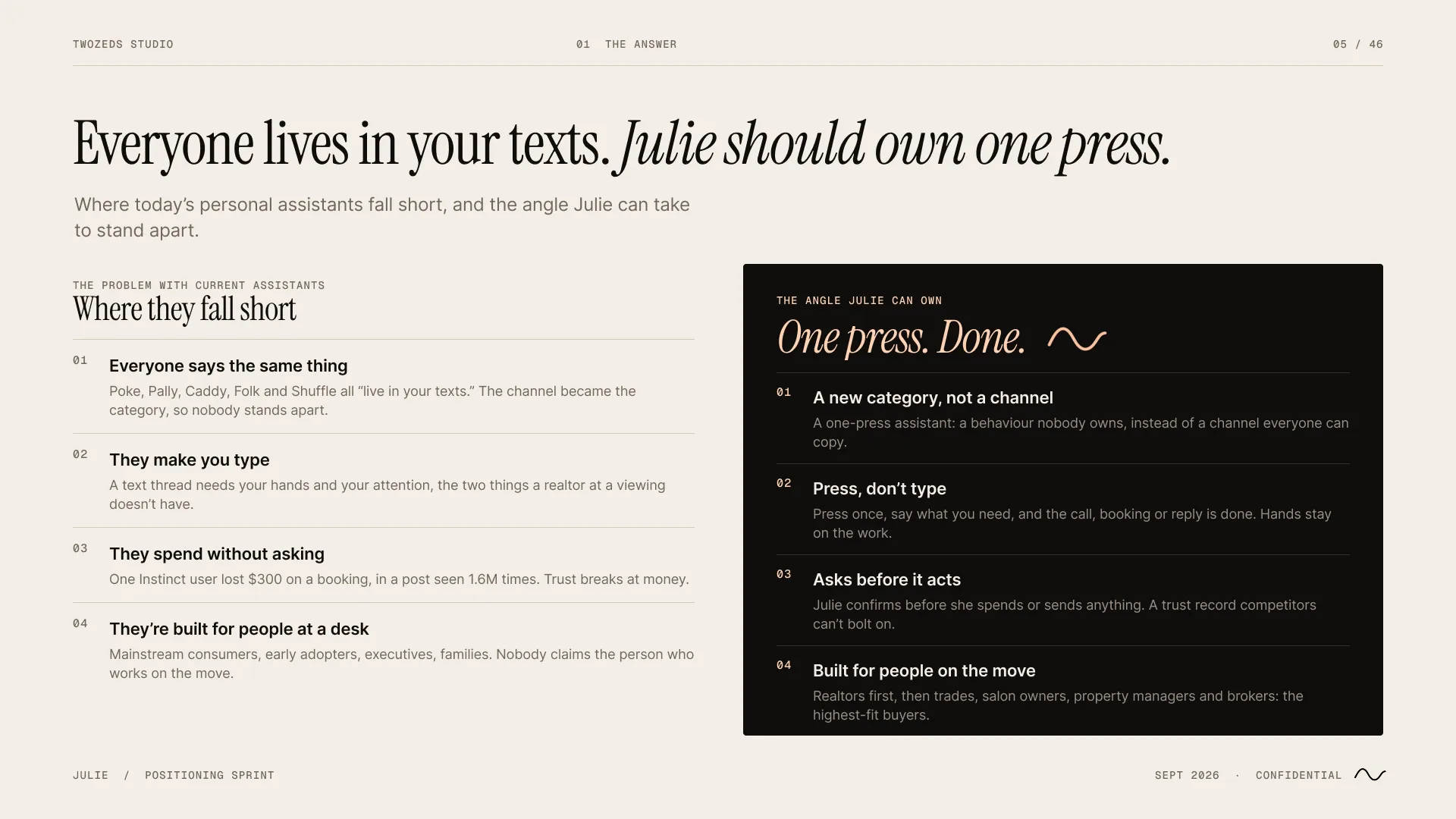
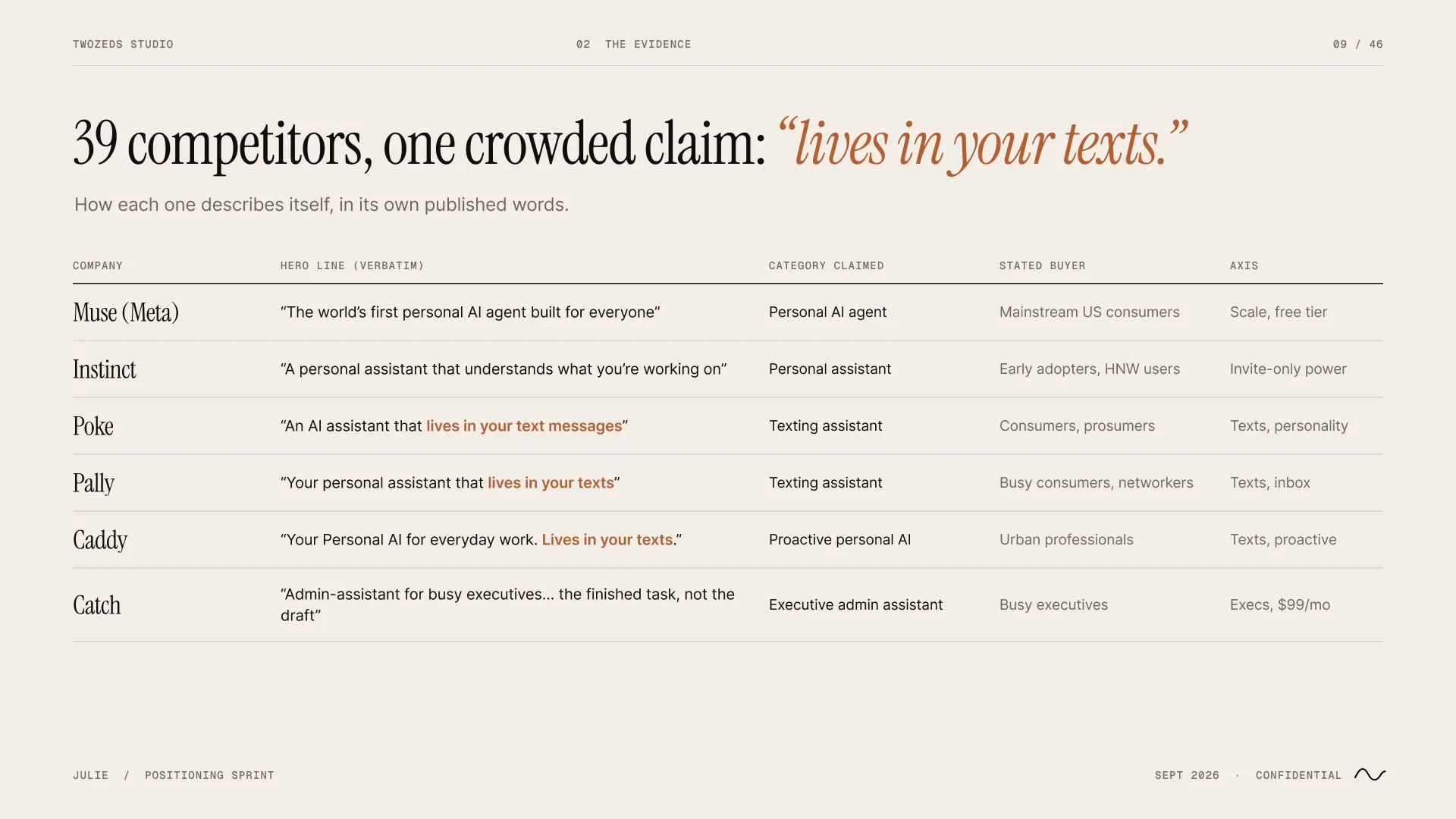
We mapped 39 competitors. Poke, Pally, Caddy, Folk and Shuffle all describe themselves as living in your texts, almost word for word. A channel anyone can copy had stopped separating anyone.
Trust breaks at money.
The loudest negative moment in the public posts we reviewed was a user losing $300 when an assistant booked without asking. An assistant that spends has to show it asks first.
Nobody builds for people who work on the move.
Competitors aim at mainstream consumers, early adopters, executives or families. None claims the realtors, trades and owner-operators whose phone is their office and whose hands are busy.
One press, not another texting assistant
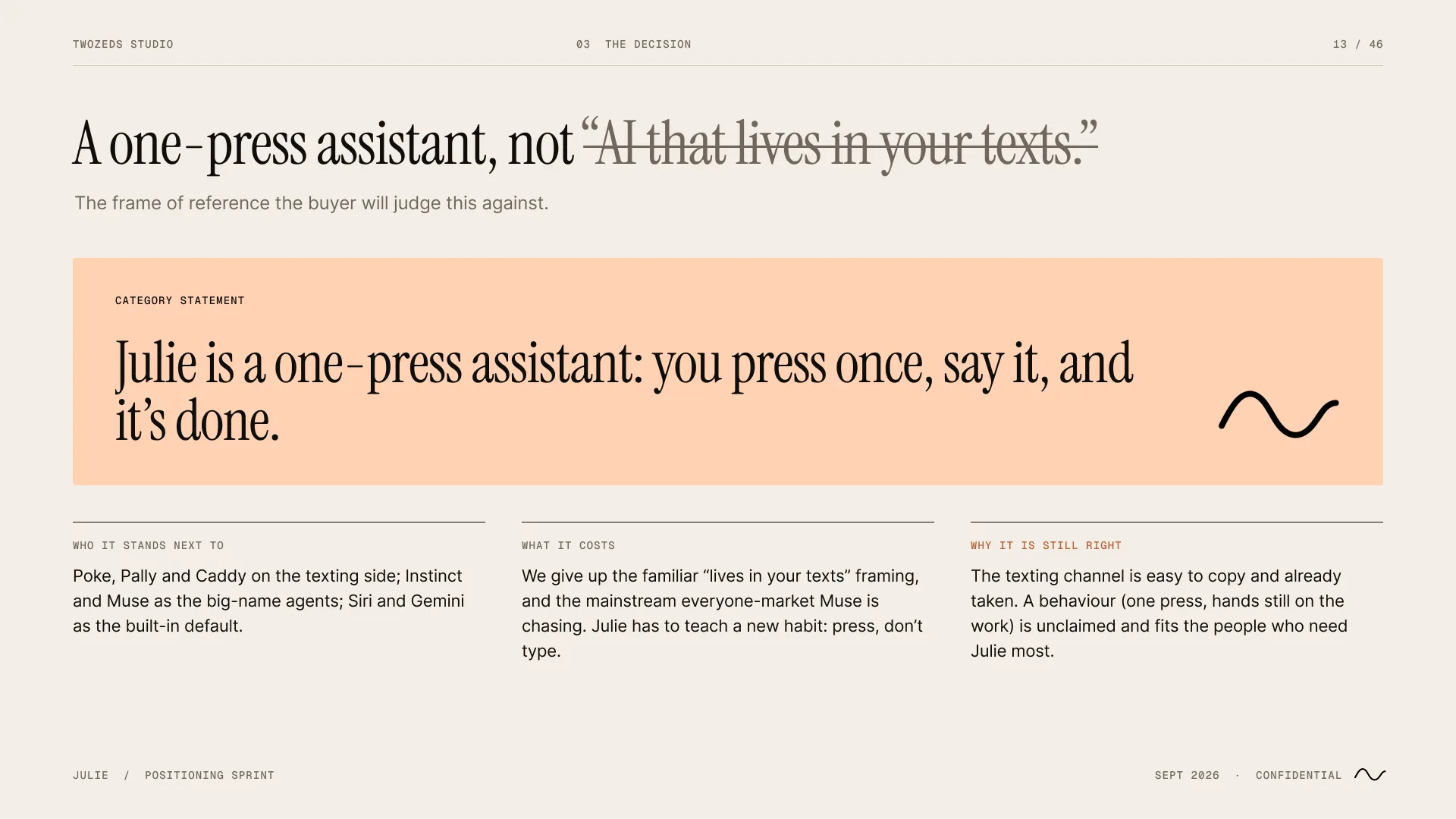
Julie is the one-press assistant for people who run their work from their phone.
The category moves from a channel (texts) to a behaviour (one press, hands still on the work). Nobody owns that behaviour, and it fits the people who need Julie most. It costs something: Julie gives up the familiar framing and has to teach a new habit, press, don't type.
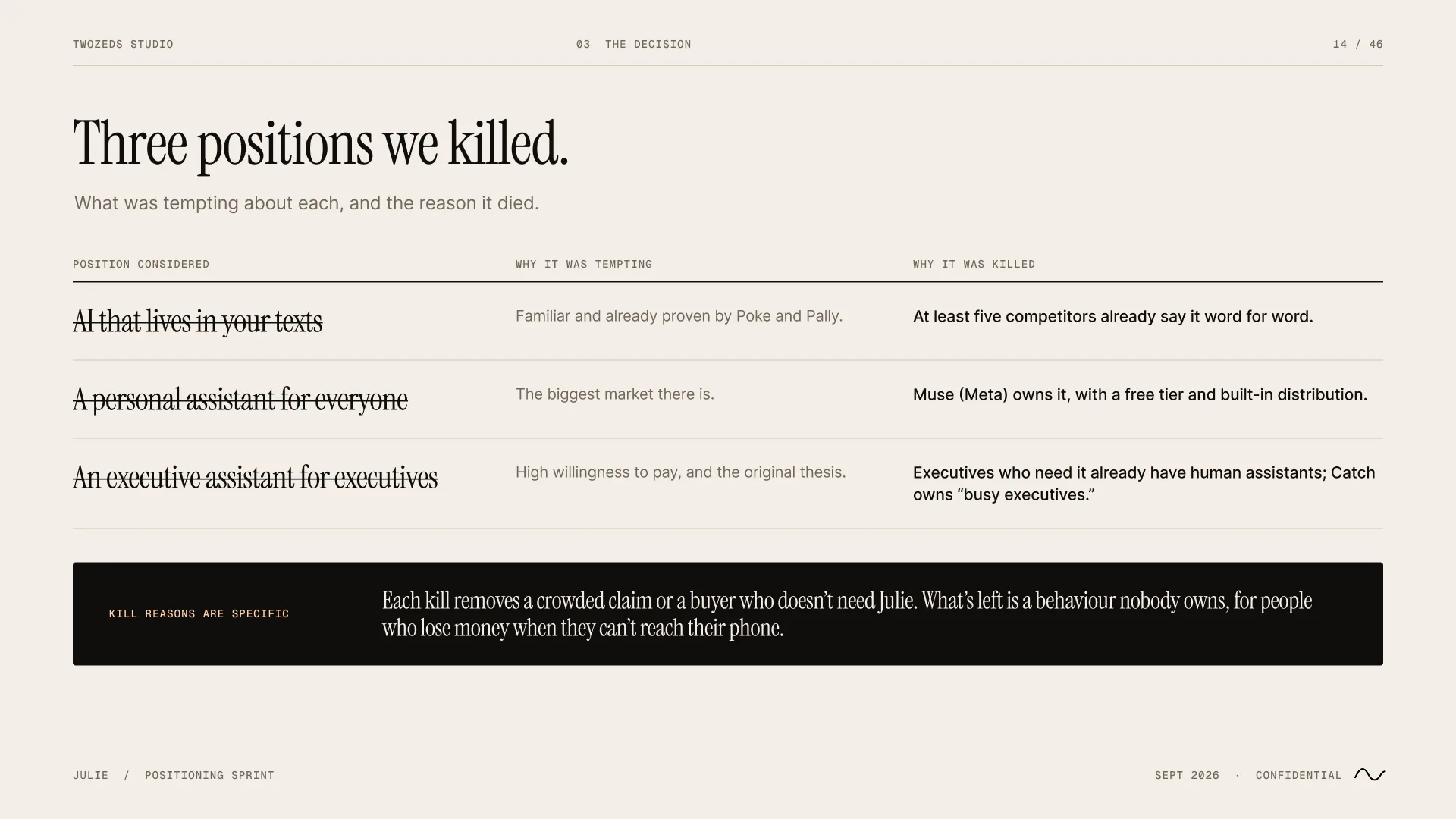
Three positions we killed
| Position | Why it was tempting | Why it died |
|---|---|---|
| AI that lives in your texts | Familiar, already proven by Poke and Pally | At least five competitors already say it word for word |
| A personal assistant for everyone | The biggest market there is | Meta's Muse is chasing it with a free tier and built-in distribution |
| An executive assistant | High willingness to pay; the original idea | Executives who'd pay mostly have human assistants, and Catch already owns "busy executives" |
Before and after
Before
"One unified agent, personalized for you." / "Life just got easier."
After
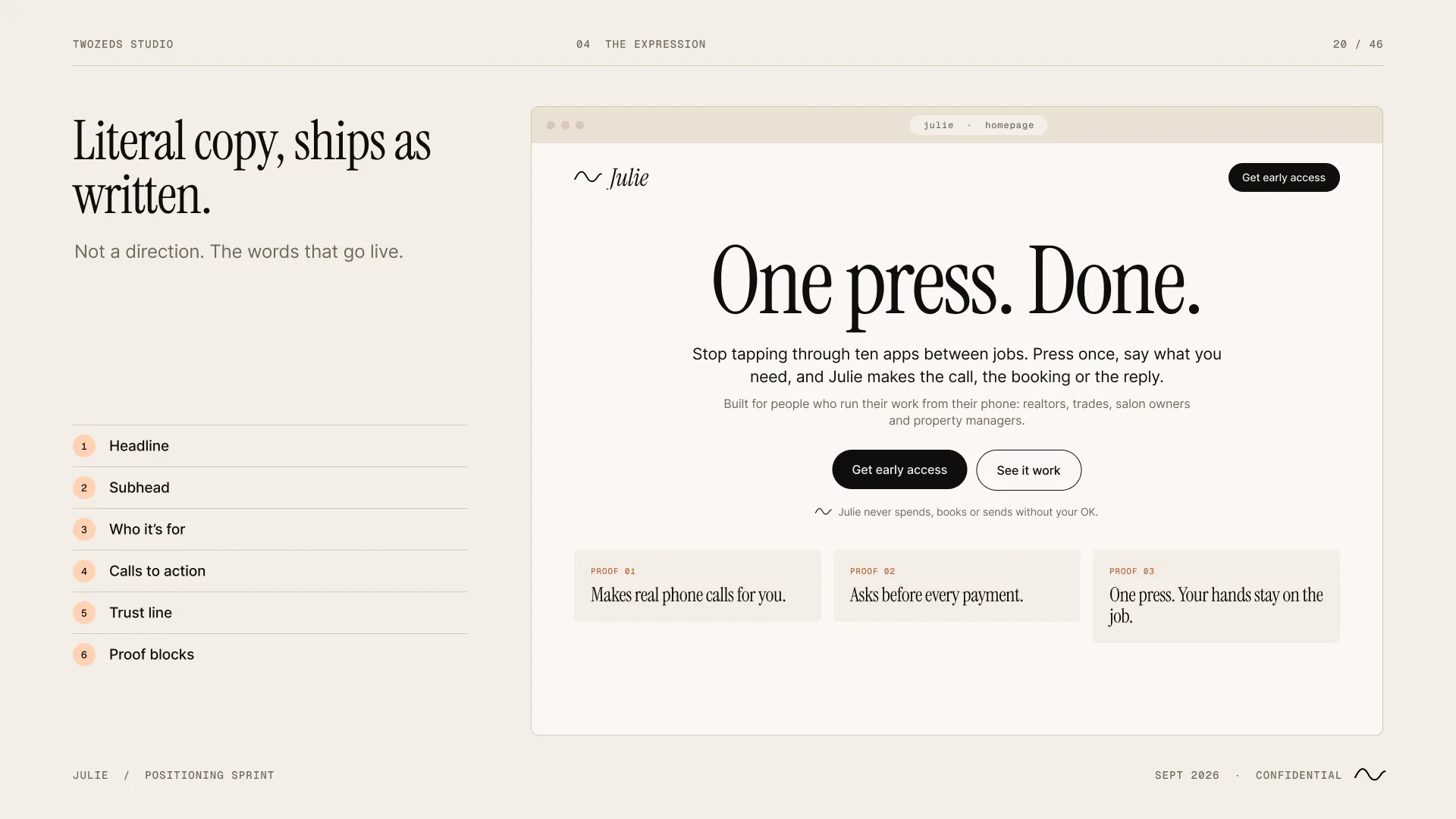
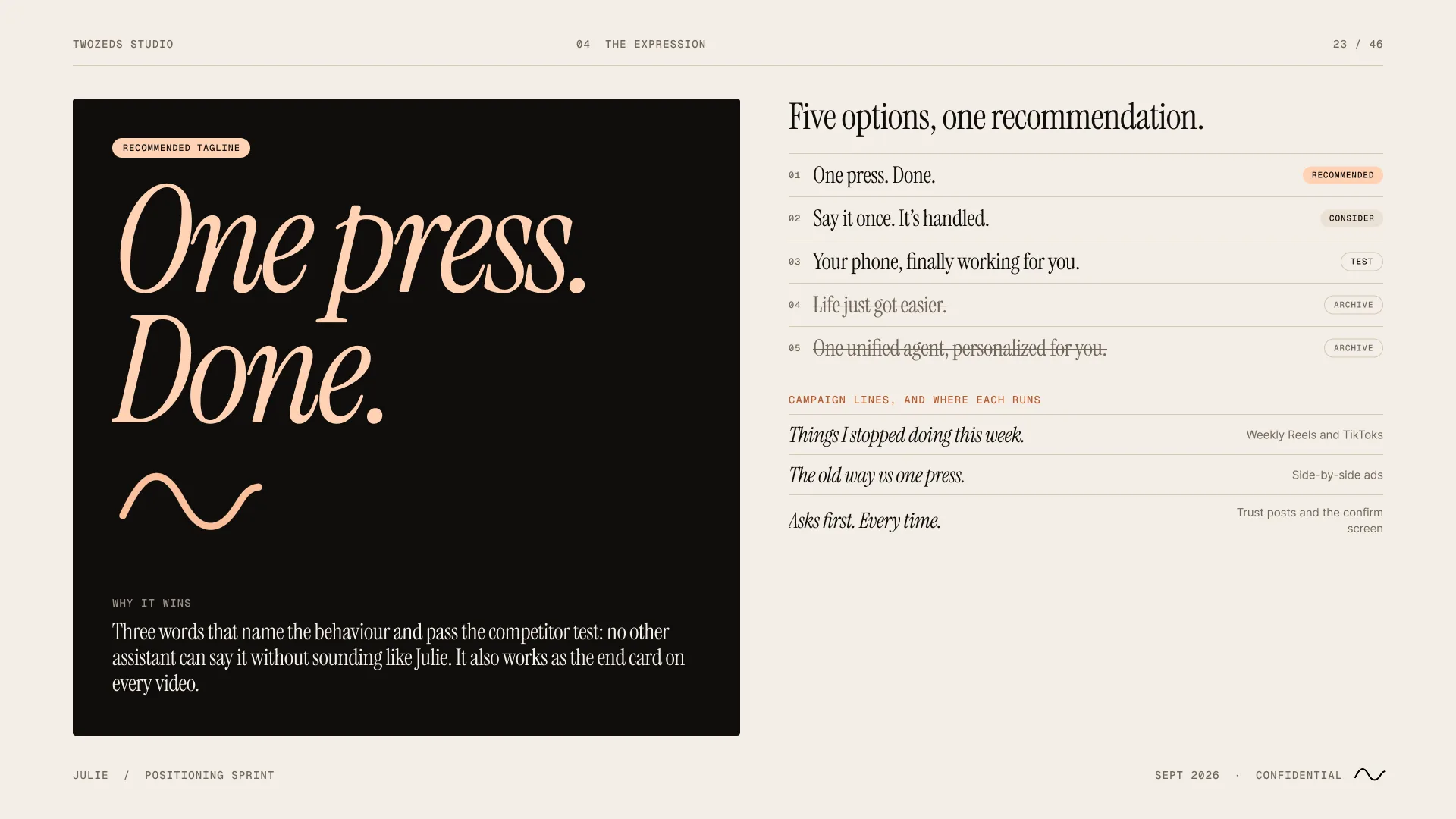
"One press. Done." Stop tapping through ten apps between jobs. Press once, say what you need, and Julie makes the call, the booking or the reply.
How Julie sounds
One claim, three proofs.
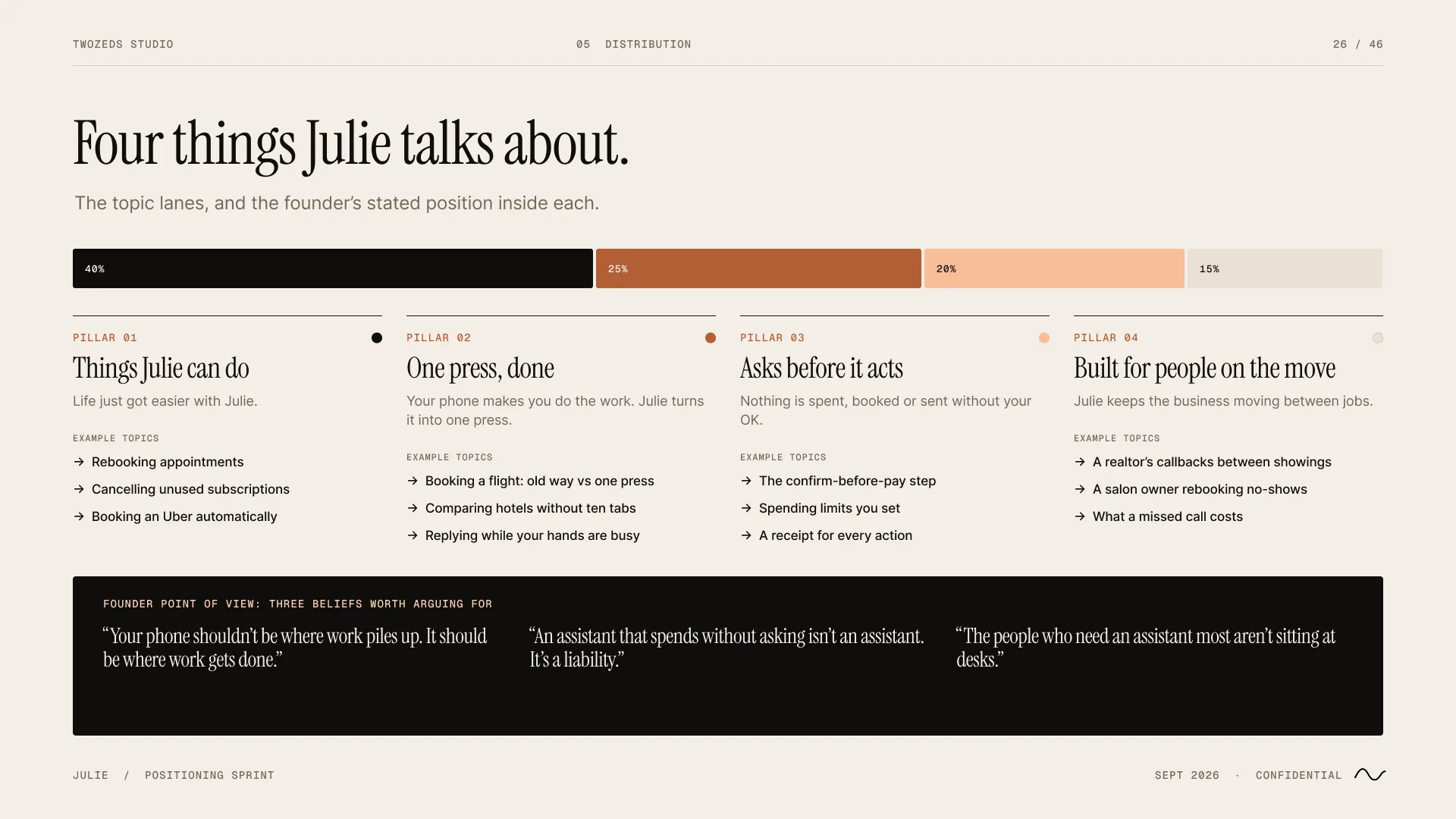
Every message ladders up to "One press, and it's done." Under it sit three pillars (it does the work, it asks first, it's built for work on the move), and no pillar ships until its proof exists.
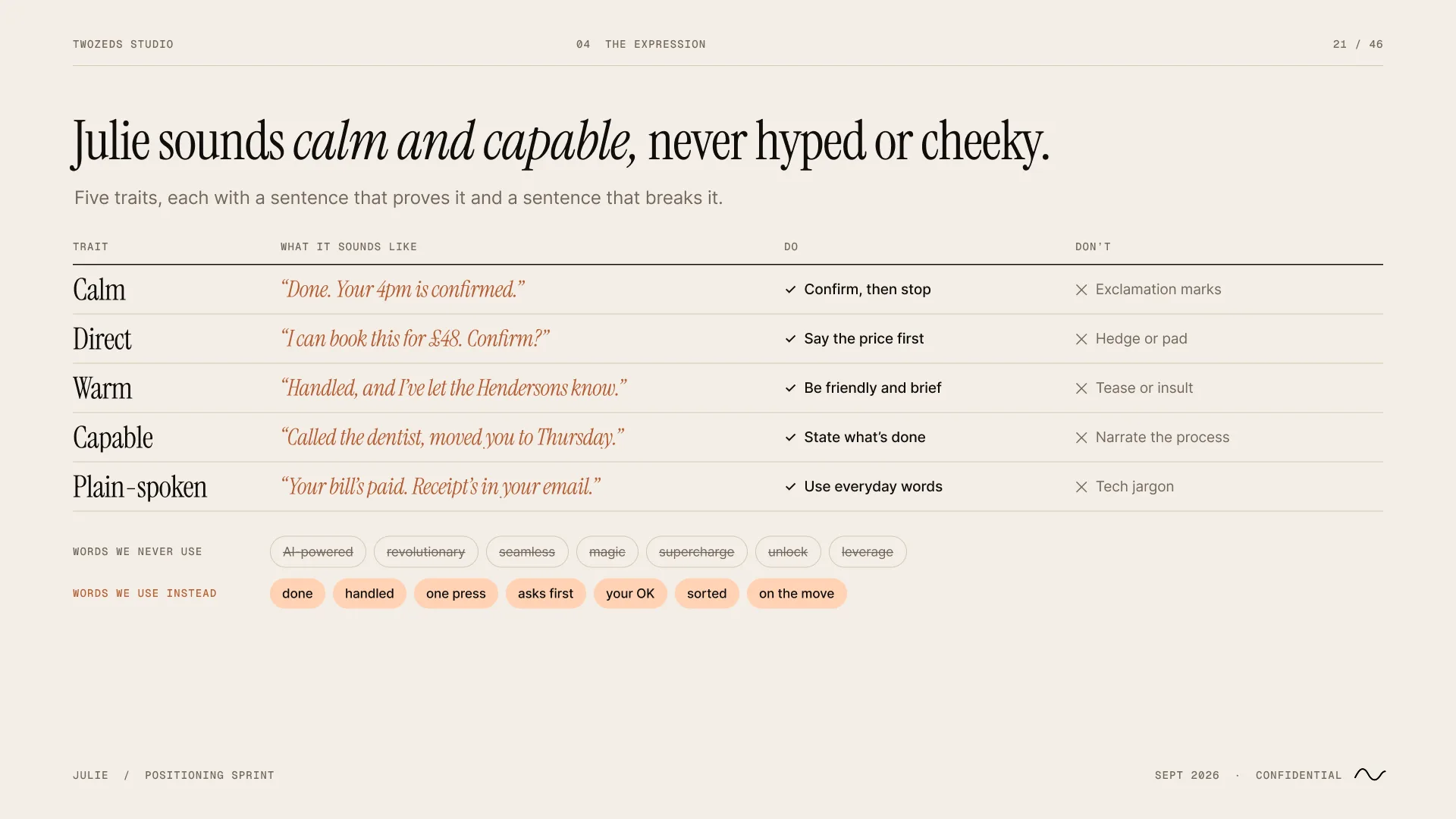
A voice that confirms, then stops.
Calm, direct, warm, capable, plain-spoken. "Done. Your 4pm is confirmed." Never "AI-powered", "seamless" or "supercharge".
Words Julie owns.
"One press" for the behaviour, "asks first" for the trust promise, "the long way" for the enemy, and "handled" to close every finished task.
Built to spread
Positioning that isn't posted is only a document. So the sprint ends in a content system the founder can run from day one:
Four content lanes,
each with a stated point of view, topics, hooks and an example video and post.
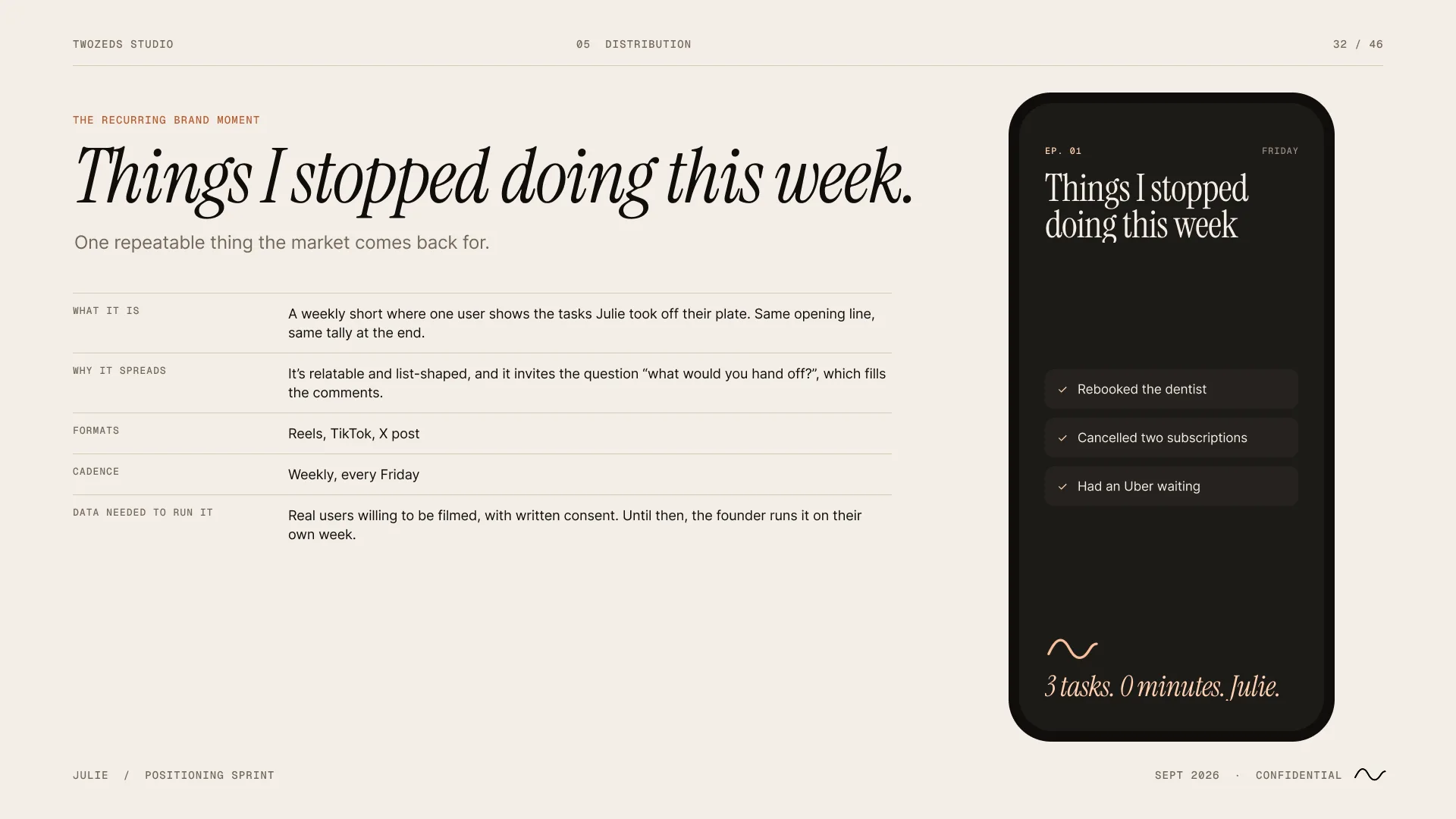
One recurring moment,
"Things I stopped doing this week": a weekly short with the same opening line and the same tally at the end.
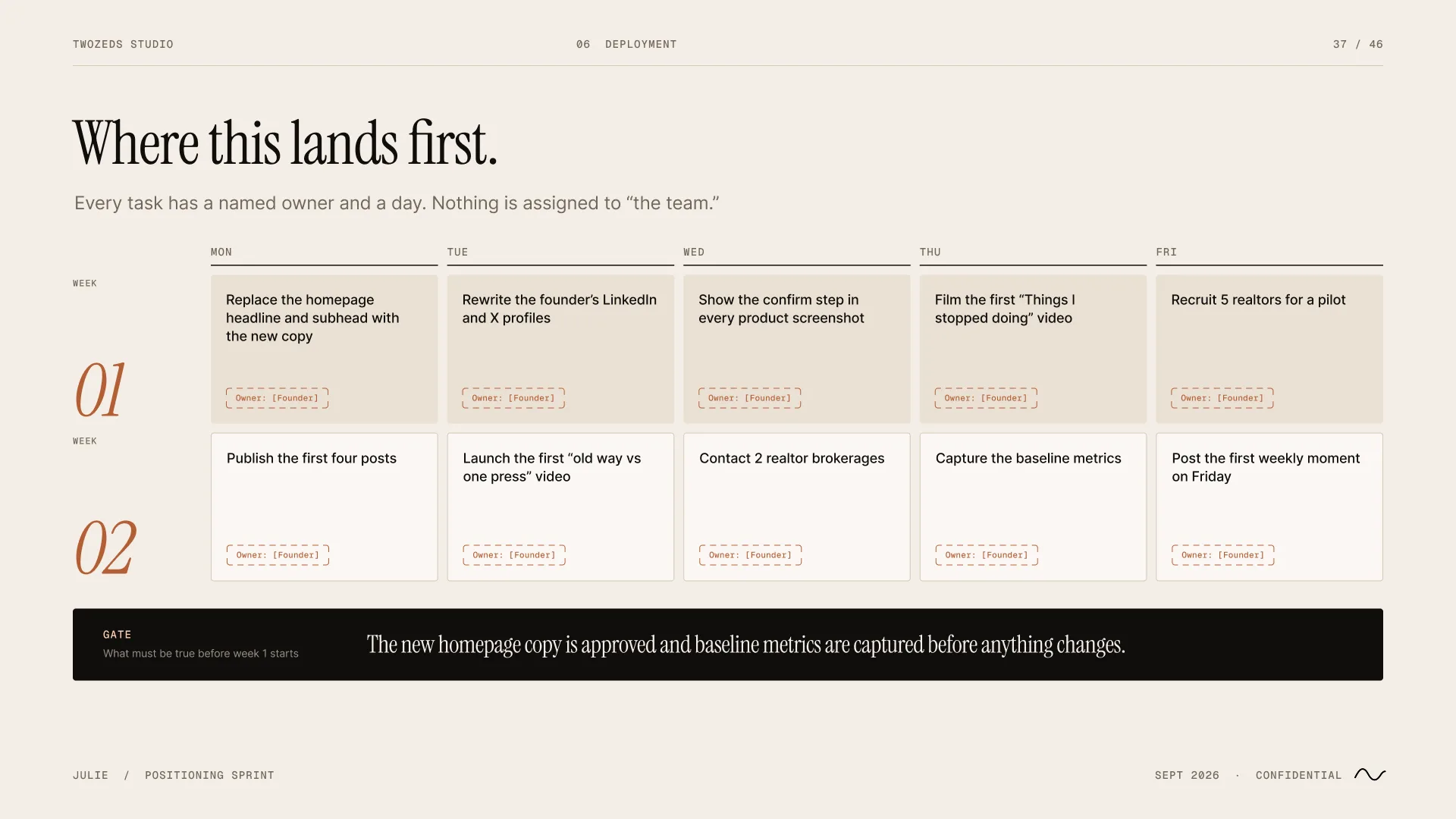
Thirty opening hooks,
ready to post, plus a two-week rollout with an owner and a day for every task.
Where it stands
The positioning, messaging and content system are done. Julie's identity, site and launch visuals are next, and this page will grow as they ship. What it doesn't prove yet: a realtor pilot and launch numbers. We'll add those when they're real.
Want this for your company?
We run this sprint for seed-stage tech startups: one position, the words that go live, and the content system to spread it.
Book a call